
Our Work
September 30, 2025
Boundless Grasses and Dark Skies: Kissimmee Prairie
Written by Corridor Connect Fall 2025 Intern Adam BehringPhoto by Ethan Coyle
After a couple of hours of driving from central Florida, we were greeted by the vast grasslands of Kissimmee Prairie Preserve State Park. The rutted road shook awake my passengers: my wife, the deft navigator, sat in the passenger seat while my brother and his wife occupied the back seat, along with the camping gear that spilled over from the trunk. I slowed the car down to a crawl, and we rolled down the windows to soak in the expanse of nature as we crept down the road to our camp site.
Before us stretched the largest remaining tract of Florida dry prairie that is spiderwebbed by sloughs and trails. It’s a land that experiences both frequent floods and fires. The timing of these events leads to an ecosystem where trees struggle to become established; instead, grasses and herbaceous shrubs dominate the landscape.
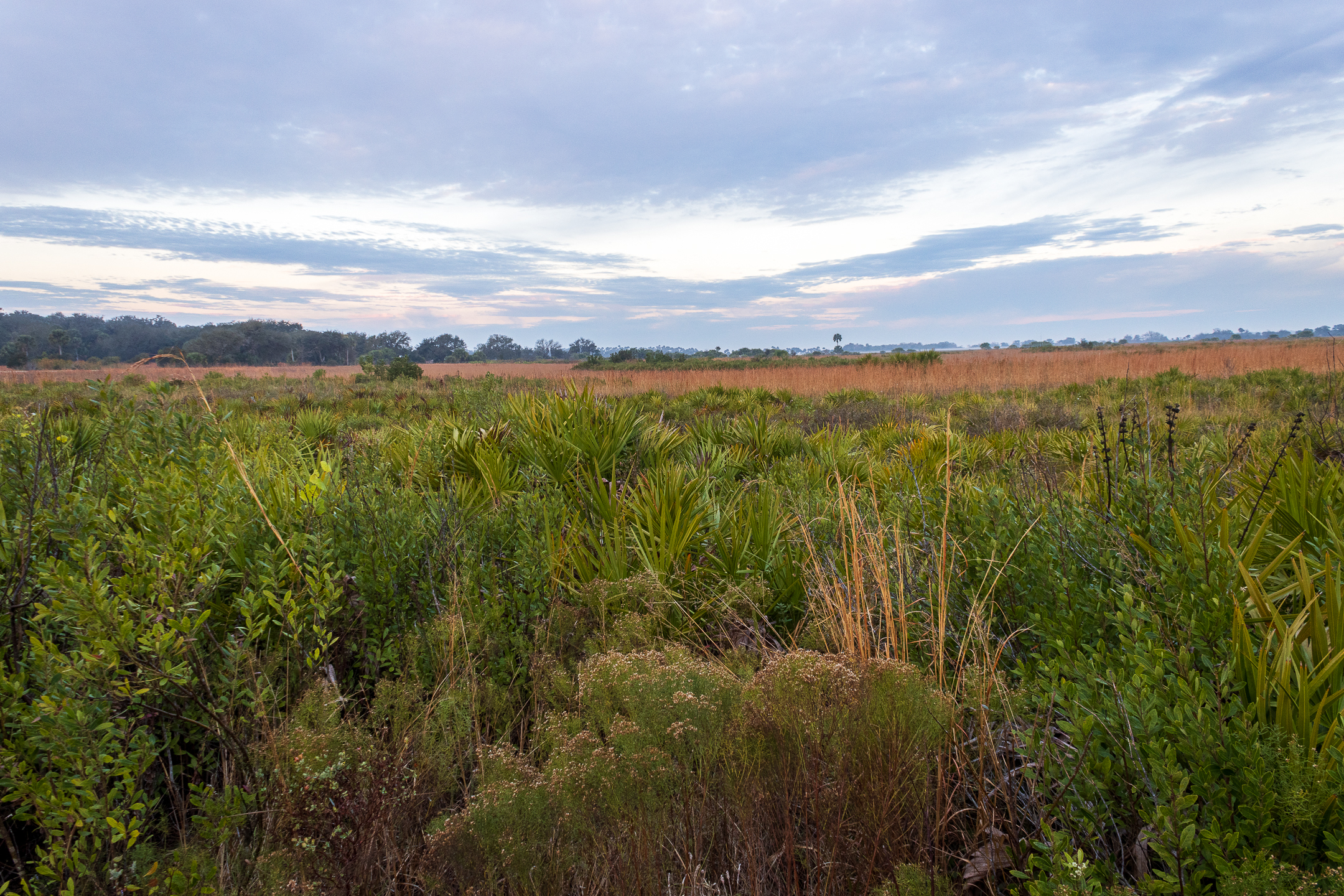
Photo by Ethan Coyle
The saw palmettos flanking the dirt road led us to the campground. The air was just starting to cool off, a welcome break from the midday heat. Like a lot of outdoor adventures in Florida, we plan camping trips around the temperatures, and this October night was a good choice. This camping trip, however, had an extra consideration. With just a few days before the new moon, conditions for stargazing would be close to ideal.
Kissimmee Prairie is a Dark Sky Park, a privilege also shared with Big Cypress National Preserve. Both of these protected parks lie with the Florida Wildlife Corridor, and are committed to reducing light pollution and embracing natural darkness. The light pollution from the artificial light of our cities has divorced us from the night sky of past generations. Parks like Kissimmee Prairie allow you to reconnect with these ancestral night skies.
Making use of the remaining daylight, our crew went about establishing our camp. The tent got raised and staked, the air mattresses inflated, plastic bins of snacks piled on the picnic table. With all of the chores out of the way we ventured out to explore.
Where we strive to do better
In front of the visitor center we found a patinated bronze bird statue. A plaque nearby told us about the Carolina parakeet. These small green native parrots once ranged across the continent. Their feathers were sought by collectors, and their presence was despised by farmers due to their “pest” status. Their gregarious nature led them to form large flocks, to the benefit of the hunters trying to dispatch them. This pressure, along with habitat destruction, proved to be too much for the small bird. By 1860, sightings of the parakeet were rare outside of Florida, and by the turn of the century they were restricted to populations in central Florida. The last wild nest was observed in what would become Kissimmee Prairie Preserve in 1904, and the last captive Carolina parakeet died at the Cincinnati Zoo in 1918. A decade later the birds were being formally declared extinct. What’s left of the species today are paintings hung on walls, specimens in museum drawers, and a bronze statue staring off toward the last known wild habitat of the Carolina parakeet.

Photo by Alex Freeze
We failed the Carolina parakeet, but there remains a chance for a little brown bird that still makes its home in Florida’s dry prairies. Florida grasshopper sparrows, named because their song is reminiscent of their buggy namesake, have experienced dwindling populations due to habitat loss and invasive fire ants that prey on their ground nests. Their very specific habitat requirements puts them in a tight situation. They prefer the grasslands to build their nests among the vegetation, and require bare soil brought about by fires for foraging. Tragically, much of Florida’s dry prairie habitat has been lost, and because these birds nest on the ground, the remaining nests are especially vulnerable to predation. Work continues to safeguard the prairies that are left and protect nesting sites to give these little guys a fighting chance.
Innumerable points of light

Photo by Ethan Coyle
We found the astronomy pads just a short walk from the visitor center. Only red lights are allowed here after dark. This is to not interfere with any astronomy equipment and preserve one’s night vision. My wife made sure to purchase headlamps with a red light mode, so we wouldn’t look like the amateurs we were. A short inspection of the astronomy sites was all we needed as the real draw would be later on. Returning to our campsite we started preparing dinner. A few hours, some s’mores and a bag of firewood later, the four of us were ready to play astronomers. Donning our red light headlamps, we retraced our earlier steps.
Arriving back at the astronomy pads we found a small group gathered around a telescope for what sounded like a proper astronomy lesson. We threw down a blanket and tried our best not to disturb them. The next 40 minutes were spent trying to figure out the night sky photography settings on our respective phones and cameras. Not letting technology make the best of us, we finally turned our phones skyward. We shared the only tripod we brought among us to stabilize our phones for their five minute long exposure time. While I waited for my photo to finish, I laid back trying to pick out individual pricks of light in the sky among the vast amount that stared back at me.

Photo by Adam Behring
The Florida Wildlife Corridor focuses on the land, but the sky is just as important to protecting wildlife. Insects, birds, mammals, and even plants can be adversely affected by light pollution. Along beaches, streetlights can lead newly hatched sea turtles away from the ocean and into danger. Dark Sky parks can be a refuge for nocturnal animals to live their lives in the way they prefer.
People, likewise, benefit from a night sky. It was relatively recently that artificial light masked the stars from us. What once inspired artists and scientists, rituals and myths, and what led humanity across oceans is now overshadowed by the glow of our cities. As much as the darkness is important to animals, it is equally important to us. It reflects our natural and cultural heritage just as much as the prairies, mangroves, swamps, or forests.
After the requisite five minutes, I was rewarded with a photo of a star speckled sky. With the long exposure time, my camera yielded even more stars than I could see with my eyes. Innumerable points of light. We spent hours sharing the photos we captured among ourselves and taking in the grand view.

Photo by Adam Behring
Before turning in, I set my alarm for one final event. Early in the morning I made everyone get up to watch the sunrise over the prairie. Armed once again with phones and cameras we patiently waited in an empty campsite for the first rays of sunlight to peek over the horizon. A fitting end to our nocturnal adventure and bright start for our trip back home. We left back down the same rutted dirt road with the sorrow for never knowing a lost bird, a sense of grandeur of a starry night, and a greater appreciation for the uniqueness of Florida.

Adam Behring | Corridor Connect Intern
Adam Behring is a native Floridian who grew up in Clearwater and is completing a Master’s degree in biology at Miami University. He previously studied computer science at the University of Central Florida and the Air Force Institute of Technology, before working as a civilian with the United States Navy in Orlando. After a decade with the Navy, Adam decided to follow his passion by studying biology. His coursework and projects focus on building curiosity for, and appreciation of, plants through storytelling. This has led him to work with the Jacksonville Zoo and Botanical Gardens, Conservation Florida, and the Florida Native Plant Society. He is excited to contribute his expertise to the mission of the Florida Wildlife Corridor Foundation and to further conserve Florida’s natural heritage. Adam lives in Tallahassee, where he enjoys hiking, board games, craft beer, and tending to the native plants around his home. He definitely doesn’t bring cool bugs inside to show his fantastic and understanding wife, Amber. Together, they also serve the whims of two adorable cats, Growler and Cooper.
More Corridor News & Stories

October 5, 2026
September 2026 Newsletter
Florida is getting its first taste of fall, and we’re happy to be experiencing it in the Panhandle alongside our partners at our...

September 30, 2026
September 2026 Cabinet Conservation Approvals
TALLAHASSEE, FL – On September 29, the Florida Governor and Cabinet approved funding for the permanent conservation of 8,838 acres across seven properties...
September 1, 2026
Community Harvest: Eat Well & Do Good for Wild Florida
Eat well and do good this September. You can support the Florida Wildlife Corridor Foundation just by dining in September at any of...
September 1, 2026
August 2026 Newsletter
As August comes to a close, Florida’s summer landscape is alive with new beginnings. Across the Corridor, summer rains are breathing new life...
All News & Stories


